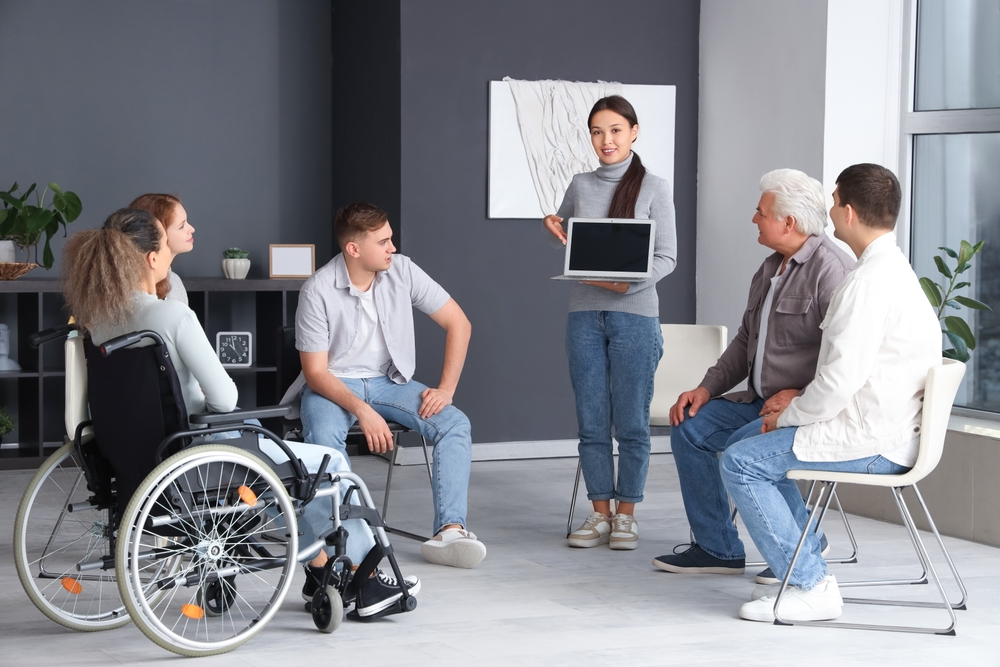
Skills-based volunteering means giving an organization the thing you are already good at — bookkeeping, design, grant research, photography, HR, carpentry, translation — rather than a generic pair of hands. Four hours from someone who can build a budget often moves a small nonprofit further than a full Saturday of general help. In a county this size, both kinds of volunteering matter, but the first one is chronically in short supply.
The reason is simple. General volunteer shifts are easy to advertise and easy to fill. Specialist help is neither. A treasurer who understands fund accounting, someone who can write a case statement, a photographer who will hand over usable files — those roles usually get filled by whoever is already standing there, or they do not get filled at all.
What Separates Skills-Based Volunteering From Showing Up to Help
It is not a status ranking. A food drive still needs people to sort and carry, and an event still needs someone at the registration table. The distinction is about what the organization gets back for the hours it spends managing you.
| General volunteering | Skills-based volunteering |
|---|---|
| The organization trains you for the task | You arrive already able to do the task |
| Value scales with the number of hours given | Value scales with the difficulty of what you produce |
| Usually a shift: setup, serving, sorting, cleanup | Usually a project: a budget, a website, a policy, a photo library |
| Easy to fill from a sign-up sheet | Usually filled by asking a specific person |
| Ends when the shift ends | Leaves something behind that keeps working |
Both are volunteering in the ordinary sense of the word: time given freely to an organization or cause. That is worth saying because the term gets tangled up with court-ordered or graduation-required hours, and the difference between community service and volunteering is a useful thing to have straight before you offer anyone your time.
Why Small Organizations Need Specific Skills More Than Extra Hands
Most nonprofits in a rural county are running on a handful of people, some of them unpaid. The work that stalls is rarely the visible work. Nobody forgets to hold the fundraiser. What slips is the accounting cleanup, the grant deadline nobody had time to research, the website that has been broken on mobile for a year, the donor list living in three spreadsheets.
Those are the jobs a skilled volunteer can close out in a weekend and a staff of two cannot get to in a quarter. Here is the kind of thing that gets asked for locally:
- Finance and bookkeeping — reconciling accounts, building a budget an outside reader can follow, preparing figures for a board meeting
- Writing — grant applications, a case for support, newsletters that actually go out on schedule
- Technology — fixing a site, setting up a donation page, moving records out of paper and into something searchable
- Photography and video — usable images of real programs, which is the single most common thing small organizations do not have
- Trades and facilities — electrical, plumbing, carpentry and accessibility work on buildings that communities still use
- Event and project management — running a timeline, a vendor list and a volunteer roster so the same three people do not carry it
What You Get Back
The honest answer is that it varies with the role. What holds across most of it: you learn how a thing gets funded and run, which is knowledge that transfers; you meet people you would not otherwise meet, in a county where that matters; and you get to see the result, which is much harder in a large organization far away.
There is a professional dimension too, and it is real enough that hiring managers ask about it. A volunteer role with a title, a term and a countable outcome reads differently on an application than a list of hours. That side of it — how to decide which roles qualify and how to write them up — is covered in the Foundation’s guide to whether volunteering counts as work experience. This page is about the other side: what the work does for the place you live.
Volunteer Burnout Is Usually a Scheduling Problem
Burnout among volunteers rarely arrives as a dramatic exit. It looks like a reliable person answering emails more slowly, then arriving late, then saying they are just busy for a while. The cause is usually structural rather than emotional: the role expanded past what was agreed, or it was never defined in the first place.
A few things prevent most of it.
- Agree the scope out loud, before you start. What is the task, who is the point of contact, when is it finished? A project with an end date is far easier to sustain than an open-ended promise.
- Commit to what you can repeat, not what you can manage this month. Two hours you will still give in April beats eight hours in September followed by silence.
- Say what you are not doing. Skilled volunteers get pulled sideways because they are competent. Naming the boundary early is kinder to everyone than resigning later.
- Ask for a hand-off, not a heroic finish. If a role has outgrown you, the useful contribution is documenting it so the next person can pick it up.
Organizations carry the other half of this. A role description, an orientation, a named contact and a thank-you that mentions something specific will keep a volunteer longer than any recruitment drive.
Where Skills Are Needed Across Miami County
The Miami County Community Foundation is a 501(c)(3) established in 2007, based in Paola and run with a volunteer board. It holds and manages charitable funds for individuals, families, businesses and churches, and much of what it pays out it deliberately calls donations and contributions rather than grants. Its work reaches Paola, Osawatomie, Louisburg and Spring Hill, and its scholarships reach the high schools in Paola, Osawatomie and Louisburg plus Prairie View in La Cygne.
Three of its programs show what specialist help looks like in practice. Shifting Gears funds suicide-prevention training delivered directly to public and private schools, with no county limit. Stomp Out Suicide funds prevention work in public schools across Miami and Linn County: speakers, teacher training, and counseling paid for individual students. Avelyn SonShine Journey gives children’s bibles to churches and youth groups; it does not award money. There is no application form for any of them — contacting the Foundation is the process, applications are accepted year-round, and a decision usually follows about a month later. You can read the current programs on the Foundation’s grants and scholarships page.
Around that sit the organizations named on the Foundation’s site as having received its support, among them the Miami County Historical Museum, the Paola Community Garden of HOPE, Lakemary Center, Cops for Tots, the Paola Senior Center, the Salvation Army, United Way and USD #367. The Foundation also hosts an all-day Miami County Non-Profit Gathering, which is the fastest way to meet several of these groups at once, and it keeps a county-wide events calendar covering everything from the Paola Roots Festival and the Louisburg Cider Run to Chamber Coffee mornings that rotate through Osawatomie, Paola and Spring Hill. Every one of those events needs somebody who can run a registration desk, chase sponsors, or take photographs that are worth publishing.
Students have a structured route in. The Miami County (MICO) Youth Leadership Council runs a full year: counselors at Louisburg, Osawatomie and Paola each select four seniors and four juniors, 24 students in all. The Council meets monthly, carries out a philanthropic project, and its members sit in on Foundation board meetings.
How to Start Without Overcommitting
- Name the skill, not the cause. "I want to help" is hard to place. "I do payroll and I can give one evening a month" places itself.
- Pick one organization or one issue. Spreading across four causes is how people end up doing nothing well and feeling guilty about all of it.
- Ask what is actually missing. The obvious role is often already covered. The unglamorous one usually is not.
- Start with a defined piece of work. One project, one season, one event. Extend it if it works.
- Reassess after the first round. If the fit is wrong, say so early and hand it over cleanly.
If you do not know which door to knock on, the Foundation is a reasonable first call. It is in contact with schools, nonprofits, businesses and donors across the county, so it usually knows who is short of what. Call Tammy Booe at (913) 404-7287 or email info@micocf.org.
Skills-based volunteering is one way of giving back to the community. Smaller gestures count too, as 50 acts of generosity shows, and ways to make a lasting impact looks at the longer view. Employers can formalize this with an employee volunteer program.
Give the Thing You Are Good At
Nobody needs to solve the county’s problems in a year. A local organization that has been carrying a broken website, an unreconciled ledger or an unwritten grant application needs one person who can fix that one thing, and then perhaps stay. Skills-based volunteering is mostly the willingness to say out loud what you are good at, and to offer an amount of time you will still be able to give in six months.
Tell the Foundation with what you do and how much time is realistic, and the Foundation can point you at the organizations that need it. If time is the thing you do not have, giving to a fund that already supports this work is the other route in.